



BEIJING, Nov. 2, 2026 — RoboScience, a full-stack embodied intelligence company, today announced the close of a Series A2 round totaling several hundred million yuan. The round was co-led by Ambrum Capital, Horizon Investment and Shanghai Semiconductor Equipment and Material Investment Management Co., Ltd., with follow-on participation from Happiness Capital, 360 Security Technology Inc., Guolian Minsheng Capital, Ginton Capital and investment vehicles affiliated with several listed companies. The syndicate’s participation reflects broad confidence in RoboScience’s technical depth and commercial potential.
Proceeds will be used to deepen the company’s commitment to embodied intelligence, with priority on continued iteration of its foundation models, proof-of-concept (POC) validation and scaled deployment across logistics, retail and industrial scenarios, and further strengthening of its senior talent bench.
From Data to Models to Hardware: A Full-Stack Embodied AI Loop Built in One Year
Deploying embodied intelligence has never been a matter of a single algorithmic breakthrough. It is a systems engineering problem spanning the entire chain — models, hardware and data. Organized around three core objectives — efficiency, accuracy and generalization — RoboScience has built a full-stack technical architecture extending from model architecture and the data loop through to the robot body itself, yielding a differentiated, system-level advantage.
Over the past year, the company has systematically staked out its position along the “general-purpose embodied intelligence” roadmap: from the launch of its in-house physics simulation engine, RoboMirage, in September 2025, to the release of its general-purpose embodied foundation model, Visics, in June 2026, and the unveiling of its wheeled humanoid robot, REX G1, in August — closing the full loop from data to model to hardware in the space of twelve months.
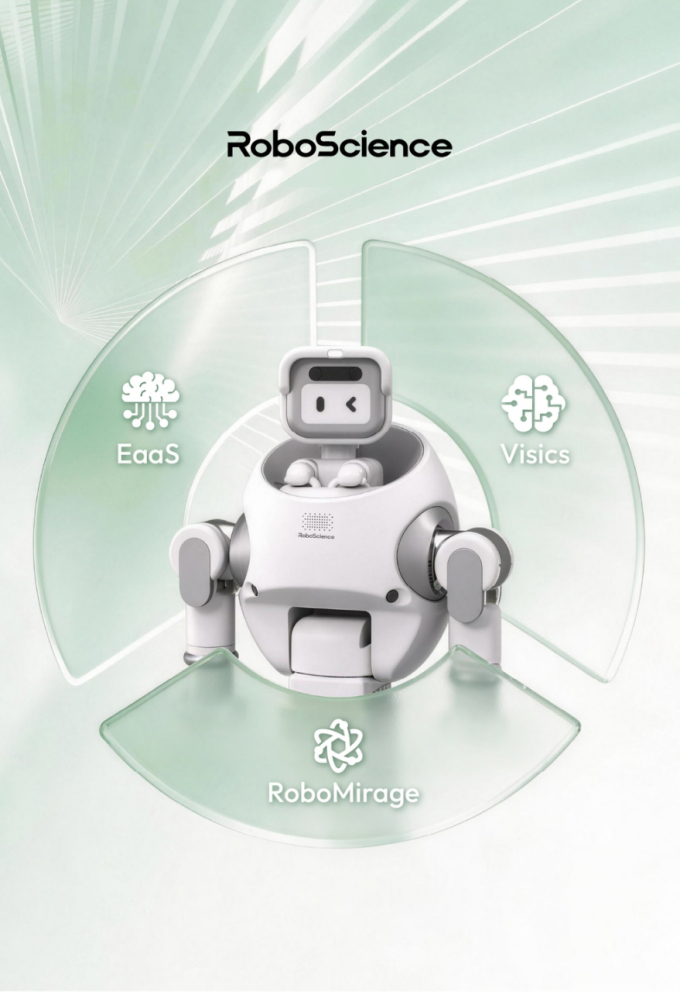
As embodied intelligence moves toward industrialization, the central bottleneck is the high cost of porting systems to new scenarios combined with insufficient model generalization. If every new scenario required fresh manual data collection, model post-training and hardware re-engineering, the resulting marginal costs would sharply cap the addressable commercial space. In RoboScience’s architecture, “data–model–body” is not a one-way linear pipeline but a mutually reinforcing data flywheel in which each component defines and amplifies the others:
- A dual data flywheel — simulation plus video — that drives the embodied scaling law. RoboMirage already delivers high concurrency, real-time performance and full object-space coverage, and combined with a fully automated video annotation and curation pipeline it forms a “simulation + video” dual data flywheel. RoboScience’s data strategy has driven the cost of acquiring a single data sample down to RMB 0.05 — one-twentieth to one-two-hundredth of conventional approaches. Between early 2026 and October, the company’s video training data grew from 1 million hours to more than 4 million hours, while simulation training data has long since surpassed ten billion motion trajectories; both classes of data continue to expand. This breaks the dual constraints of data scale and data cost at the root, creating the conditions for an embodied scaling law.
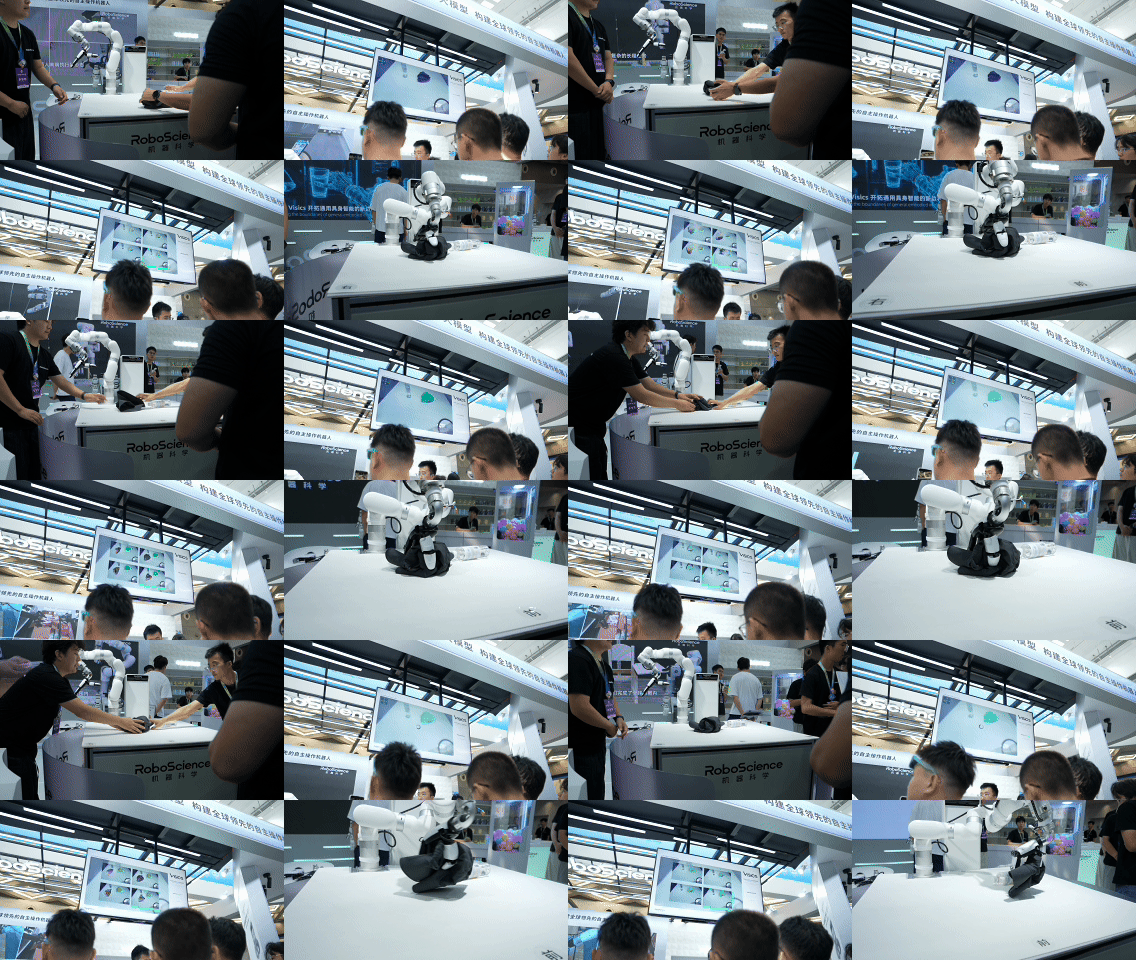
- The Visics general-purpose embodied foundation model delivers generalization along three axes: cross-embodiment, cross-object and cross-task. Visics fuses two core engines — an embodied world model and a general manipulation model — and introduces Object Trajectory as an intermediate interface, represented as continuous 3D point-cloud trajectories of objects. The upper embodied world model handles cognition and pre-simulation of physical trajectories, while the lower general manipulation model translates those trajectories into physical control signals for different robots. This cleanly decouples high-level semantics from low-level physical dynamics, with each layer pre-trained on a distinct data source: massive internet video and simulation data respectively. At this year’s WAIC and WRC trade shows, robots running Visics switched between dexterous hands from different vendors in 30 seconds with no retraining required before executing manipulation tasks, and also grasped objects handed to them at random by visitors on the show floor — a live demonstration of the model’s cross-embodiment adaptability and cross-object generalization.
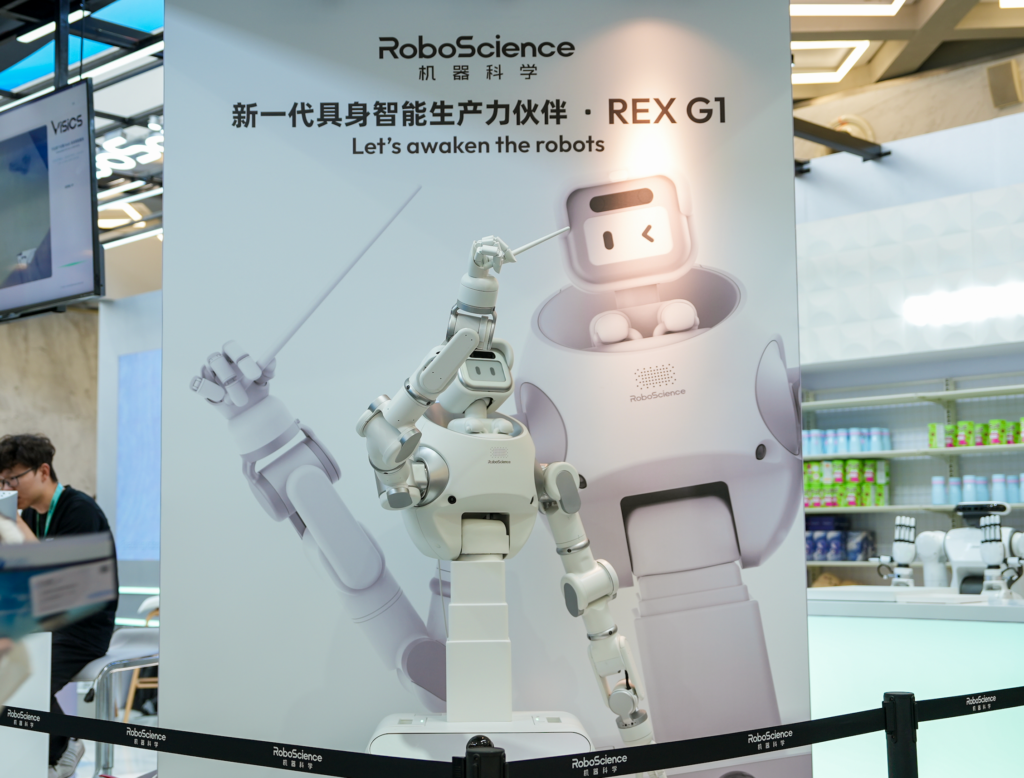
- REX G1 delivers continuous operation under real working conditions, closing the “operate–feedback–iterate” loop. RoboScience’s in-house wheeled humanoid robot integrates mobility, omnidirectional perception and dual-arm coordinated manipulation, and is designed primarily for the highly dynamic, highly generalized demands of logistics and retail. As the physical platform carrying Visics, the in-house body enables tightly coupled hardware-software optimization across transmission precision, control latency and foundation-model inference. At the same time, REX G1 captures data from complex, long-horizon tasks, which is extracted in real time and fed back into the RoboMirage simulation system to improve operational efficiency.
Bridging the Gap Between General Foundation Models and Real-World Deployment: Three Technology Pillars Build a Deep Moat
General-purpose large language models — GPT Astra and others among them — are pushing steadily into the physical world on the strength of their spatial understanding. The industry keeps returning to one core question: as general LLMs grow more capable, where exactly does the differentiated value of an embodied intelligence company’s in-house “brain” lie?
The answer is that general LLMs excel at tool use, task decomposition, chain-of-thought planning and intent orchestration, but they are not natively suited to driving heterogeneous robot bodies. The real bottleneck on the path to industrialization is the generalization of the physical manipulation execution interface, together with response speed and long-horizon task success rates. Meeting it requires AI to genuinely learn the complex physical properties of the real world: contact, friction, elasticity and dynamic feedback.
These physical laws do not simply emerge from internet text or generic video data. That is precisely the moat RoboScience has built on three technology pillars — simulation engine, general-purpose embodied foundation model and robot body:
- The RoboMirage simulation engine continuously generates massive volumes of low-cost, physics-grade data, removing the scaling-law bottleneck at its source.
- The Visics general-purpose embodied foundation model uses a hierarchically decoupled architecture to deliver unified physical manipulation control across embodiments, objects and tasks.
- The REX G1 body serves as the optimal physical embodiment of the full stack: running the in-house Visics model, it sustains a continuous loop of operation and feedback under real working conditions.
The three pillars co-evolve. They allow an AI robot to first “understand” how objects move, then flexibly call a unified model interface to precisely drive widely differing hardware bodies. With the Series A2 round now closed, RoboScience is positioned to carry this full-stack loop into a far larger commercial arena — delivering infrastructure with genuine value for generalized, real-world deployment to the global embodied intelligence industry.
Industrial Capital Backing to Accelerate Commercialization and Core Use-Case Validation
On the commercialization path, RoboScience is focused on scenarios that combine high generalization requirements with high data value. In the view of Ye Tian , founder and CEO of RoboScience, scenarios such as logistics and retail involve highly diverse objects, environments and tasks: they play to the strengths of a general manipulation model while also generating rich real-world operational data that continuously feeds back into model iteration. The company will therefore enter these generalization-intensive scenarios first, using them to drive reuse of its capabilities across scenarios, progressively lower the cost of adapting to each new setting, and establish a commercially scalable path.
To extend general manipulation capabilities across a wider range of hardware and scenarios at scale, RoboScience is translating its model capabilities into an on-demand cloud offering, EaaS (Embodied-AI-as-a-Service). The company has formed a strategic partnership with Tencent Cloud, and its in-house Visics model is now live on Tencent Cloud, exposing model access through APIs and supporting adaptation to dexterous hands, robots and other end effectors of different form factors. Users can obtain manipulation policies generated by an embodied foundation model from the cloud much as they would call a large language model — moving embodied intelligence from “body-bound” to “cloud–device decoupled,” and from technical validation toward scaled commercial use.
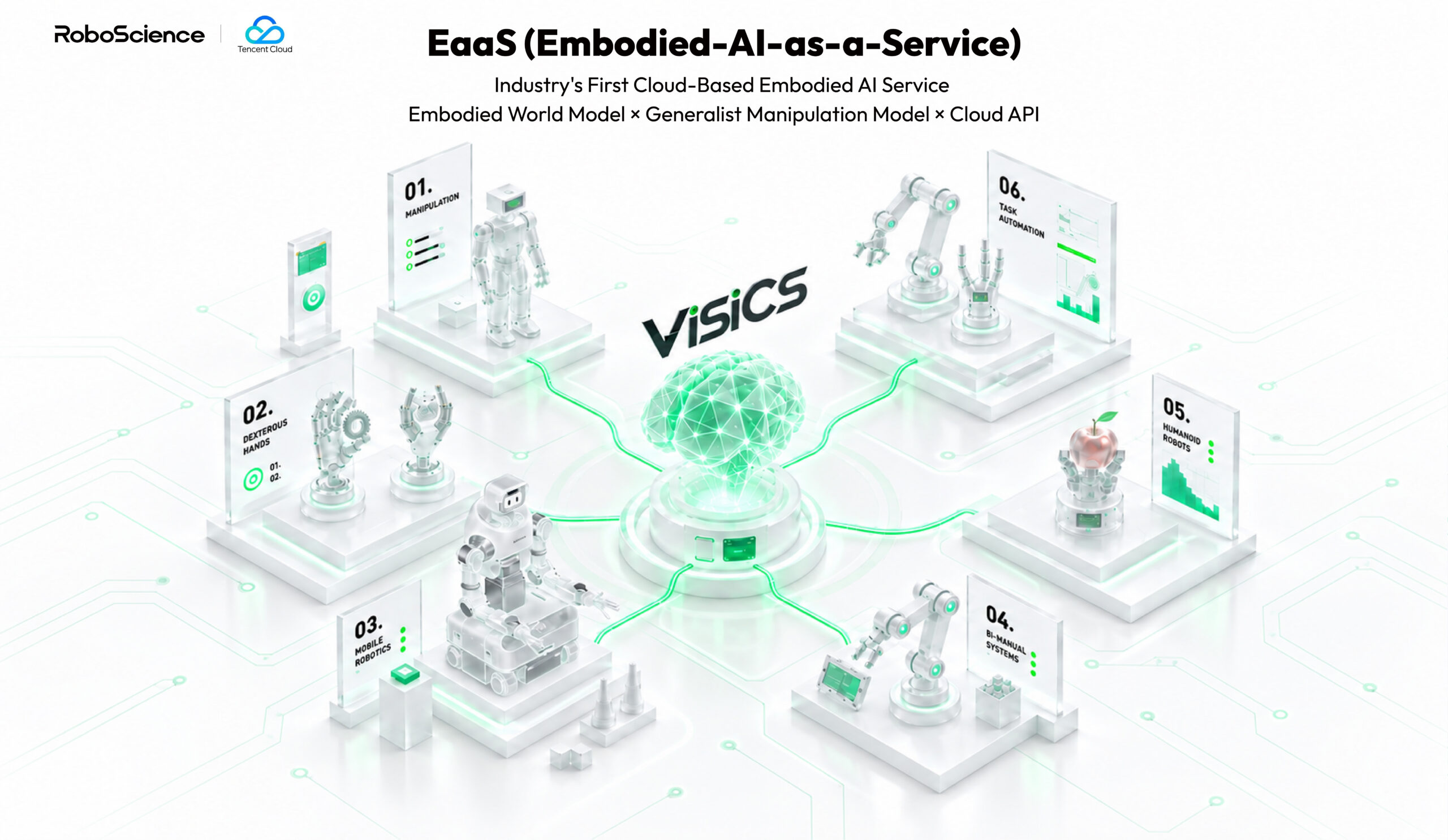
RoboScience has already begun deploying its technology in retail supermarket and logistics settings and continues to broaden the EaaS scenario ecosystem. Following this round, the company will deepen resource collaboration with its industrial shareholders and accelerate validation and rollout of its core use cases.
Amber Capital said: “Embodied intelligence is iterating quickly and, across a growing number of domains, is moving from technical validation toward scaled application. General-purpose capability in open-ended scenarios and the cost of deployment are the keys to industry breakthroughs. RoboScience has built a full-stack system spanning data, models and hardware around precisely this problem, further strengthening its ability to generalize across embodiments, objects and tasks and to accumulate data and iterate capability continuously under real working conditions. We think highly of the team’s forward-looking judgment on the technology path and its systematic execution, and we look forward to the company accelerating validation in real-world scenarios, driving scaled reuse of its model capabilities, and growing into a key infrastructure platform of the general-purpose embodied intelligence era.”
Ye Tian said: “Our goal is for every deployment to solve a real customer problem while also adding experience that makes our general capabilities stronger. Following this round, we will keep iterating Visics, refine our robot hardware and EaaS offering, and improve efficiency, accuracy and generalization in real-world operations — lowering the cost of using embodied intelligence and bringing it to every industry.”
Translator’s note: investor names are rendered by transliteration. Please confirm the official English names your investors use, particularly Amber Capital, Hongruida Investment, Shanghai Semiconductor Industry Investment, Shuang Capital, Guolian Tongbao and Jinding Capital, before distribution. 360 Corporate Ventures is also sometimes styled “360 Capital” or “360 Strategic Investment.”