



Recently, the RoboScience team released WorldFlow, the world’s first native 3D dynamics predictive world model. It enables robots to understand manipulation intentions based on observed scenes and task instructions, imagine how objects will move in 3D space next, and thereby provide more accurate object motion prediction for robotic manipulation.
For humans, the moment we reach for a cup, our brain has already simulated the grasp, movement, and placement. This instantaneous prediction of the physical world is the cornerstone of all manipulation. However, for robots to truly imagine the physical world, two major challenges remain:
Video generation models: While they accumulate rich physical interaction experience from massive videos and can generate realistic future frames, the 3D motion of objects is implicit in 2D pixel changes. Extracting this physical information requires methods like geometric reconstruction and motion tracking, inevitably introducing accumulated errors.
Skipping video generation to directly predict 3D trajectories: Although direct, this approach lacks visual signals from the physical world. The model cannot understand the contact and interaction processes of different physical entities, making it difficult to generalize its prediction capabilities.
This prompted the team to rethink: Can the rich visual information in videos allow the model to directly understand and predict 3D motion?
Based on this concept, the team officially released the world model WorldFlow. By learning to predict the motion of the 3D physical world in both real and simulated scenarios, the model breaks the disconnect between visual representations and 3D motion, providing more accurate 3D dynamics prediction for robotic manipulation.
Paper: WorldFlow: Joint Video and 3D Motion Prediction via Large-Scale Pretraining
Link: https://arxiv.org/abs/2610.39278
Project Page: https://roboscience-ai.github.io/worldflow-page/
Native 3D Dynamics Prediction: Enabling Robots to Truly “Foresee” the Future
The core innovation of WorldFlow is treating 3D motion as an independent generation modality parallel to video. The model no longer relies on trajectory extraction after video generation; instead, it simultaneously predicts future frames and the 3D motion of objects within the same generation process.
Given an observation image, a language instruction, and a target object, WorldFlow jointly predicts the future video and the 3D trajectory of the target object. Taking the example from the paper, given the instruction “Pick up the black slipper and place it on the third shelf of the shoe rack,” WorldFlow not only simulates the video of the slipper being picked up, moved, and placed, but also directly predicts the 3D movement paths and final landing points of each point on the slipper.
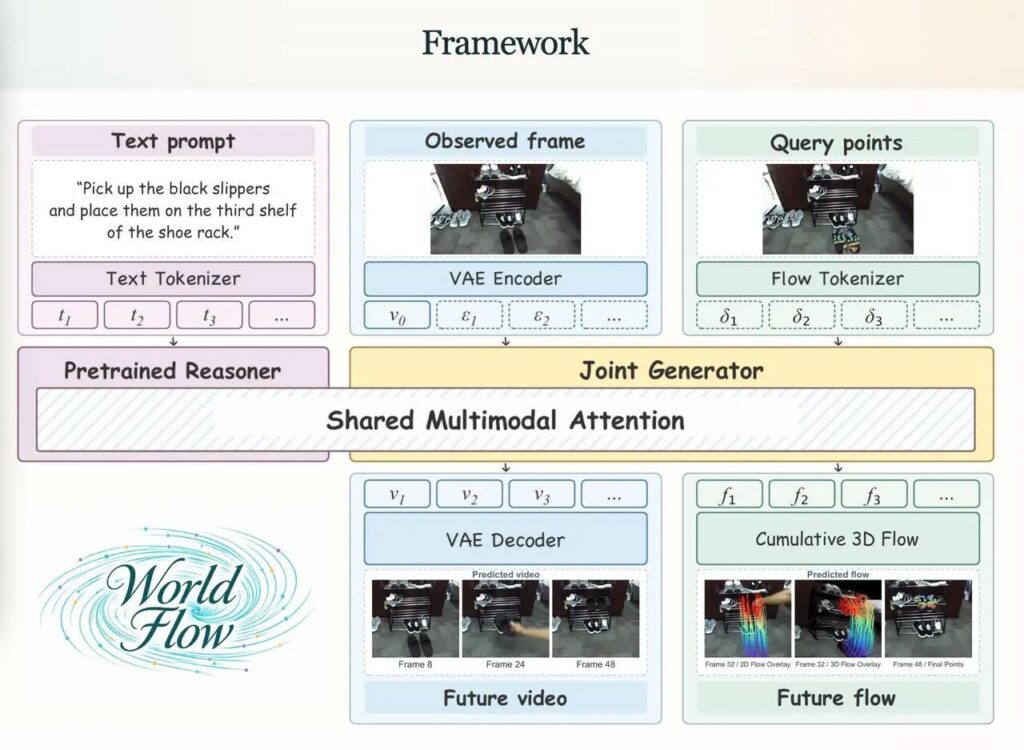
Due to the inherent gap between 2D frames and 3D motion, to help the model understand which 3D point’s motion corresponds to which pixel in the frame, the team designed two complementary encoding mechanisms: 3D point geometric encoding helps the model understand spatial positions and geometric relationships; spatiotemporal positional encoding establishes a correspondence between motion trajectories and video frames, allowing the model to associate specific object motion with relevant visual regions.
In the Mixture of Transformers (MoT) architecture, video and motion exchange information via bidirectional attention and denoise jointly in a unified generation process: video provides visual cues such as object appearance, contact, and occlusion, while 3D motion provides spatial displacement information.
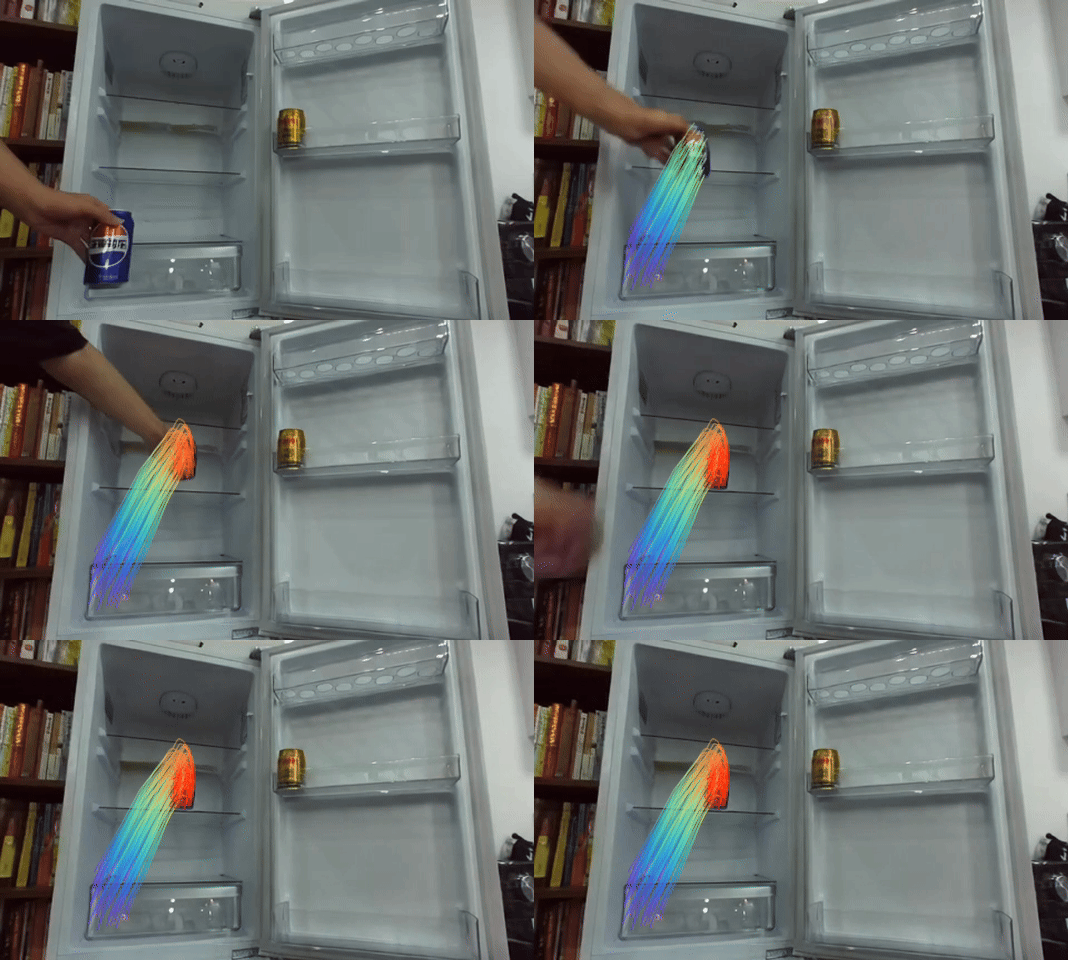
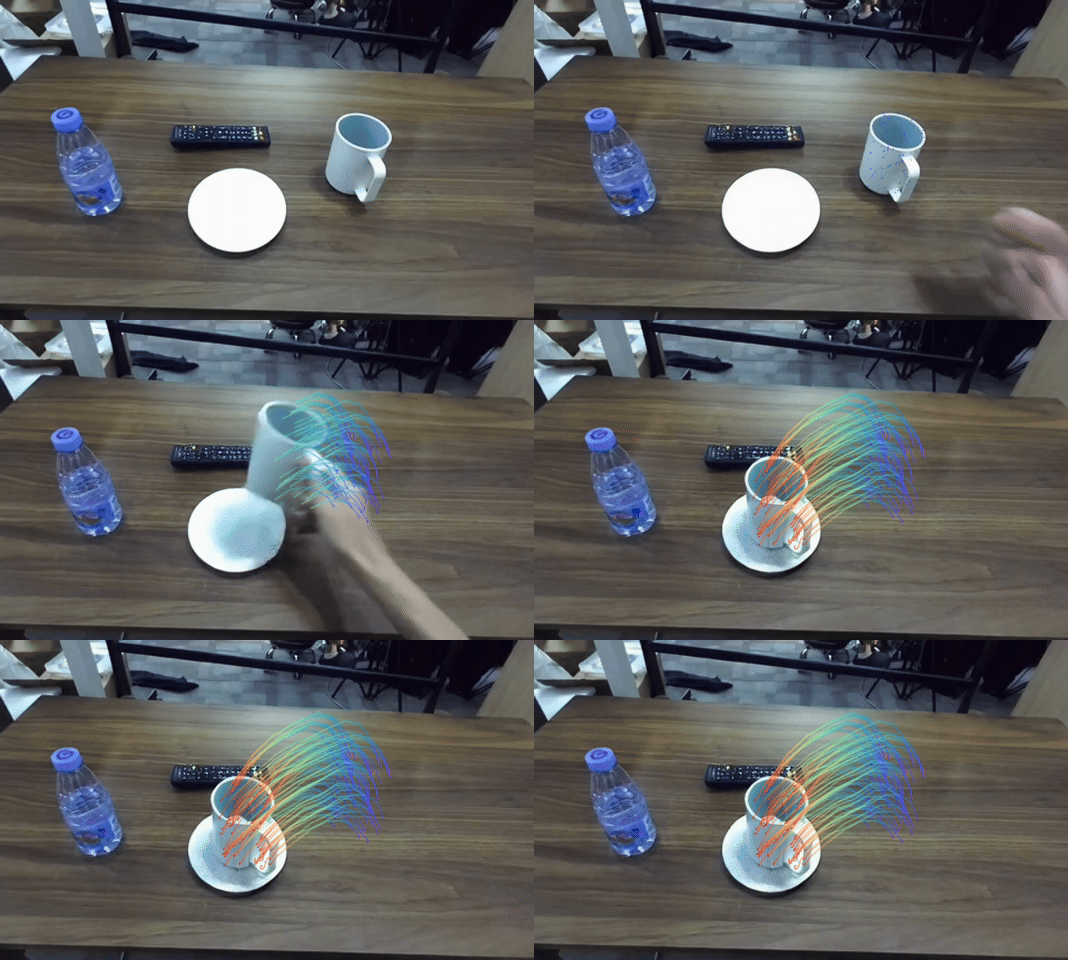
Below are the real-world reasoning results of the model in home scenarios)

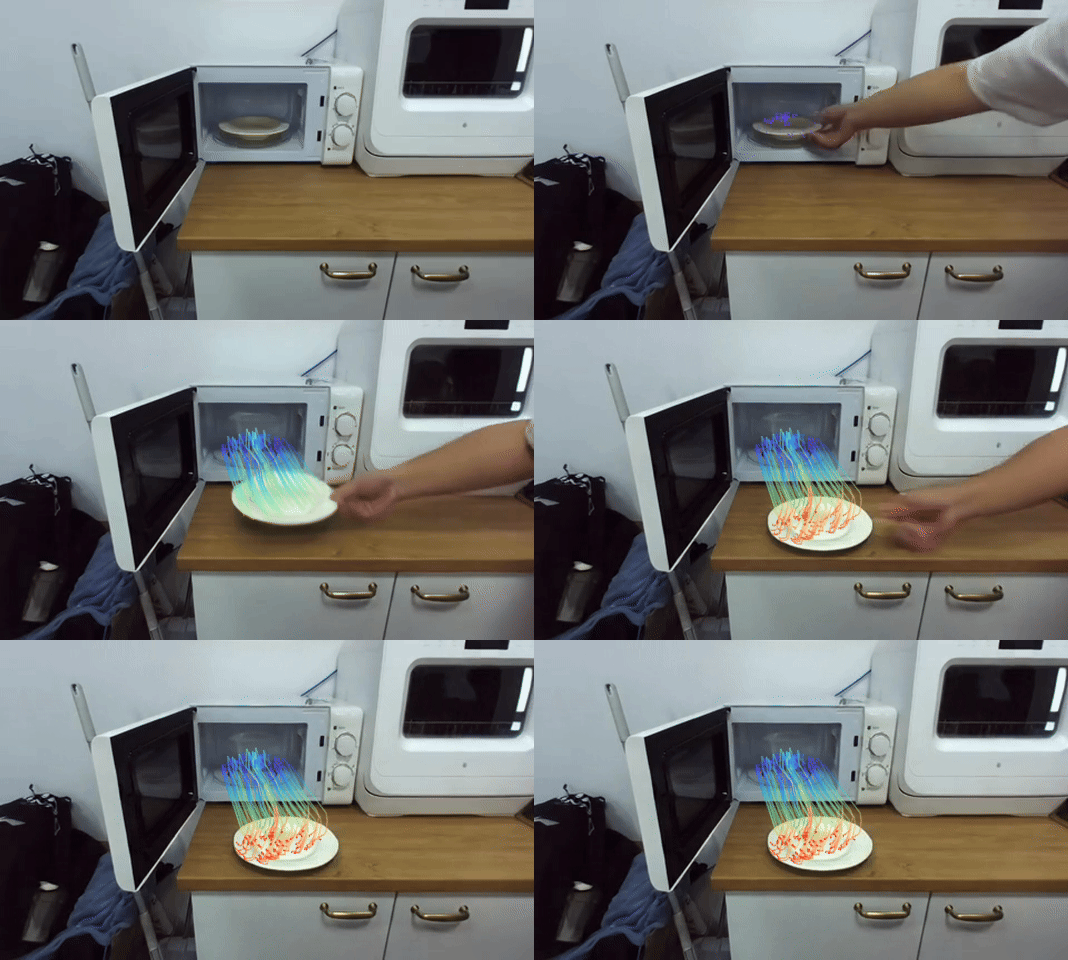

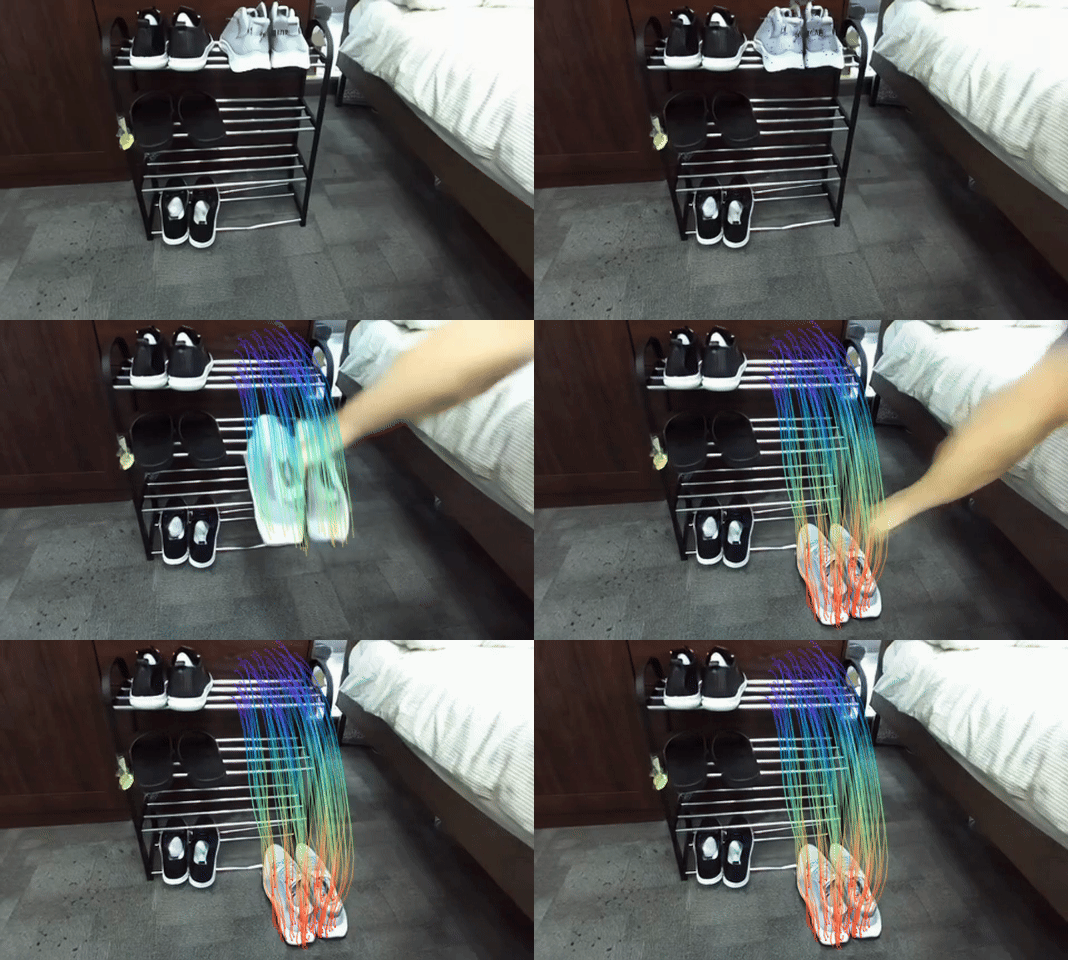
Pretraining on Millions of Multi-Source Samples: Learning Physical Motion Laws from Massive Data
To equip WorldFlow with rich object motion laws, the team built a data pipeline integrating 17 data sources from simulated scenarios, robotic manipulation scenarios, and human manipulation scenarios, constructing approximately 1.44 million training samples. Each sample contains both a manipulation video under task instructions and the 3D motion trajectory of the manipulated object. This enables the model to not only learn “how the scene should change” but also simultaneously learn “how the object should move,” acquiring 3D motion priors from diverse tasks and scenarios.
To evaluate the model’s dynamics prediction performance in robotic scenarios, the team built WorldFlowBench, a benchmark covering simulated, real-world, and spatial cognition scenarios. They assessed trajectory prediction accuracy using Average Displacement Error (ADE) and Final Displacement Error (FDE).
Ablation Studies: Why Does Joint Generation Perform Better?
Introducing video supervision outperforms “single motion prediction.”
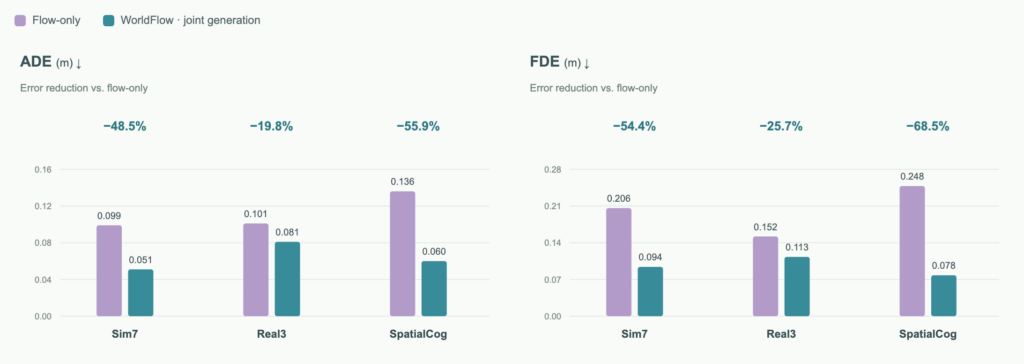
In ablation studies, the team compared WorldFlow with a variant that only predicts 3D motion. Both shared the same architecture, training data, and hyperparameters, differing only in video generation. Results show that incorporating video supervision significantly improves 3D motion prediction, reducing ADE by 48.5%, 19.8%, and 55.9%, and FDE by 54.4%, 25.7%, and 68.5% across simulated, real-world, and spatial cognition scenarios, respectively.
Direct joint generation of video and motion trajectories outperforms the “generate video then track trajectories” approach.
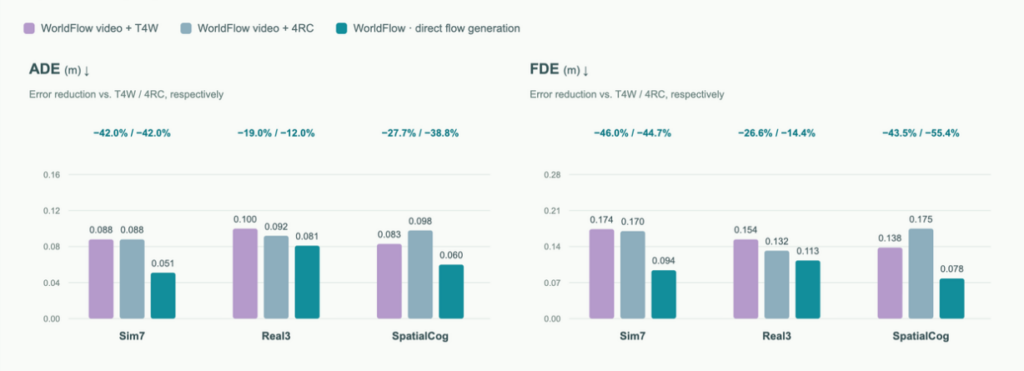
The team compared WorldFlow with two-stage methods that “generate video first, then track 3D trajectories using methods like Track4World or 4RC.” Taking Track4World as an example, WorldFlow reduced ADE by 42.0%, 19.0%, and 27.7%, and FDE by 46.0%, 26.6%, and 43.5% across simulated, real-world, and spatial cognition scenarios, respectively.
From Motion Prediction to Real-World Manipulation: Opening a New Paradigm for Embodied AI
The value of WorldFlow lies not only in improving motion prediction accuracy but also in exploring a new paradigm connecting world models to robotic manipulation: using 3D object motion trajectories as an interface to translate task intent into planning bases for robotic operations. For example, given the instruction “Place the green cookie box on the translucent box,” WorldFlow predicts the 3D trajectory and target landing point of the cookie box. The robot then combines its own arm span, joint constraints, and grasping method to plan executable manipulation actions.
In real-robot experiments, the team compared WorldFlow with the state-of-the-art motion prediction model μ₀, testing across 12 tasks to evaluate whether the model could endow robots with three types of capabilities: Pick and Place, Stacking, and Relative Placement. Compared to μ₀, WorldFlow—sharing the same grasping and control system—increased the probability of generating correct trajectories from 25.0% to 97.2%, and improved the real-world manipulation success rate from 11.1% to 66.7%.
This paradigm allows 3D object trajectories to serve as a general planning interface across robotic embodiments: for the same task, robots of different morphologies can share object motion goals and execute operations through their respective control systems. From “seeing future frames” to “foreseeing 3D motion,” WorldFlow establishes a more direct connection between world models and robotic execution, exploring a new technical pathway for general embodied AI oriented toward the real physical world.ent Error (FDE).